
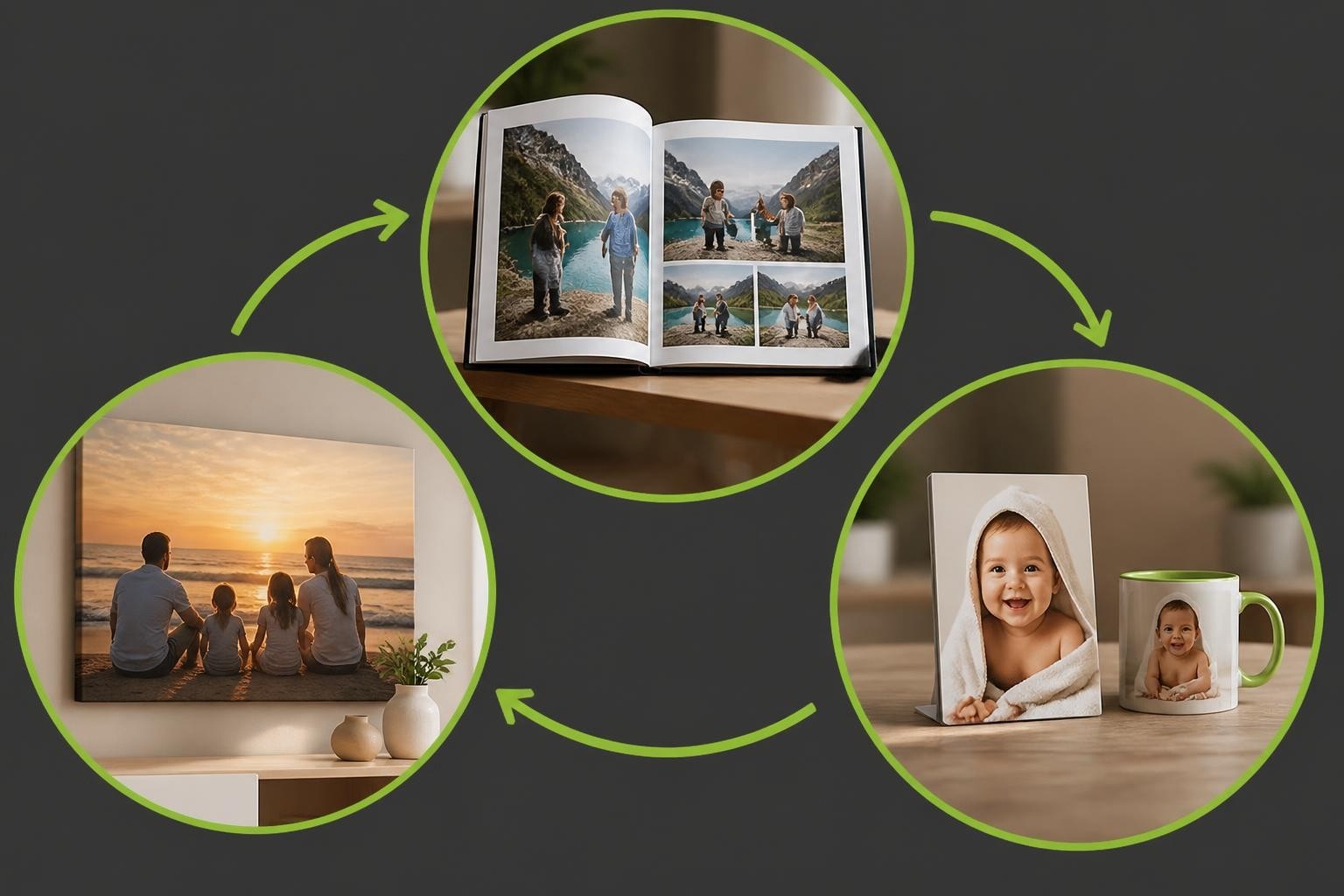
Print personalisation software has revolutionised how businesses deliver custom products to customers, transforming what was once a manual, time-intensive process into an efficient, scalable operation. Whether you're producing photobooks, calendars, greeting cards, or personalised gifts, the right software platform enables you to offer unlimited creative possibilities whilst maintaining production efficiency. This technology bridges the gap between customer imagination and physical product, empowering businesses to compete in an increasingly demanding market where personalisation isn't just expected-it's essential.
The Evolution of Print Personalisation Technology
The printing industry has witnessed a fundamental shift over the past decade. Traditional offset printing once dominated the landscape, where economies of scale demanded large print runs of identical products. Today's consumers expect something entirely different: unique, personalised items that reflect their individual stories, memories, and preferences.
Print personalisation software emerged to meet this demand, enabling businesses to produce single units as economically as they once produced thousands. The technology integrates design tools, workflow automation, and production systems into a unified platform that handles everything from initial customer interaction to final output.
Modern platforms support variable data printing (VDP), allowing different images, text, and layouts to change from one printed piece to the next without stopping production. This capability has opened new markets for photo retailers, commercial printers, and gift businesses who can now offer products that were technically impossible or prohibitively expensive just years ago.
Key Technologies Driving Personalisation
Several underlying technologies work together within print personalisation software:
- Template-based design systems that constrain creativity within printable parameters
- Asset management for handling thousands of customer-uploaded images
- Rendering engines that convert designs into print-ready files
- Workflow automation connecting front-end design with back-end production
- Quality control systems ensuring every personalised item meets standards
The sophistication of these systems varies considerably. CIP4 specifications provide industry standards for job ticketing and workflow automation, enabling print personalisation software to communicate effectively with production equipment and management information systems.
Core Capabilities of Modern Personalisation Platforms
Effective print personalisation software must balance two often-competing priorities: offering customers creative freedom whilst maintaining production efficiency. The most successful platforms achieve this through carefully designed capabilities that streamline both the customer experience and backend operations.
User Interface and Design Tools
The front-end interface determines whether customers can successfully create products without assistance. Professional print personalisation software provides intuitive drag-and-drop functionality, smart image placement algorithms, and real-time previews that show exactly how the finished product will appear.
| Feature | Business Benefit | Customer Impact |
|---|---|---|
| Auto-layout templates | Reduced design time | Faster product creation |
| Intelligent image cropping | Fewer rejected jobs | Better-looking results |
| Real-time 3D previews | Lower return rates | Increased confidence |
| Mobile responsiveness | Broader market reach | Convenience and accessibility |
Modern consumers increasingly design products on mobile devices. Software that delivers a seamless experience across desktop, tablet, and smartphone captures a significantly larger market share than desktop-only solutions.

Production Integration and Automation
Behind the customer-facing design tools, robust print personalisation software must generate production-ready files that integrate seamlessly with printing equipment. This requires sophisticated rendering capabilities that handle complex layouts, embedded fonts, colour management, and resolution optimisation.
The Ghent Workgroup provides practical guidance on PDF specifications and prepress workflows that ensure reliable output. Following these standards helps businesses avoid costly production errors and reprints.
Automation extends beyond file generation. Leading platforms connect with:
- Management information systems (MIS) for order tracking
- Payment gateways for transaction processing
- Shipping systems for fulfilment logistics
- Customer relationship management (CRM) for marketing
This integration creates a seamless flow from order placement to delivery, reducing manual intervention and associated errors.
Business Models Enabled by Personalisation Software
Print personalisation software opens multiple revenue streams for businesses willing to invest in the technology and supporting infrastructure. Understanding these models helps you align software capabilities with your strategic objectives.
Direct-to-Consumer Photobook Services
The photobook market represents one of the most successful applications of print personalisation technology. Consumers create albums commemorating weddings, holidays, family milestones, and other significant events. Photokeeps’ launch in the Philippines demonstrates how businesses in emerging markets can capture growing demand for memory preservation products.
Successful photobook businesses combine user-friendly software with competitive pricing and reliable quality. The software must handle varying skill levels, from novices wanting simple auto-layout options to experienced designers requiring fine-grained control over every element.
B2B2C Partnership Models
Many businesses lack the technical expertise or capital to develop proprietary print personalisation software. Partnership models allow photo retailers, gift shops, and online marketplaces to offer personalised products using white-label platforms provided by technology specialists.
This approach enables rapid market entry with minimal upfront investment. Businesses can focus on marketing, customer service, and brand development whilst leveraging established software infrastructure and production workflows.
Corporate and Commercial Applications
Beyond consumer markets, businesses use print personalisation software for corporate gifting, promotional materials, direct mail campaigns, and employee recognition programs. These applications often require different features than consumer photobooks:
- Brand control systems ensuring corporate identity compliance
- Bulk ordering workflows for large quantities
- Approval processes for multiple stakeholders
- Integration with corporate databases for automated personalisation
The USPS Informed Delivery programme showcases how personalised direct mail integrates with digital channels, creating measurable results through coordinated multi-touch campaigns.
Technical Considerations for Implementation
Selecting and implementing print personalisation software requires careful evaluation of technical requirements, infrastructure compatibility, and long-term scalability. Businesses must assess both immediate needs and future growth trajectories.
Infrastructure and Performance Requirements
Print personalisation software demands significant computing resources, particularly for rendering high-resolution images and generating complex PDF files. Server capacity, bandwidth, and storage all impact user experience and operational costs.
Consider these technical factors:
- Rendering speed: How quickly does the system generate previews and production files?
- Concurrent users: How many simultaneous designers can the platform support?
- File storage: What are the costs and limits for customer-uploaded assets?
- Backup and redundancy: How does the system protect against data loss?
- Security compliance: Does the platform meet data protection regulations?
Cloud-based solutions offer scalability advantages, automatically allocating resources during peak demand periods. However, businesses with existing on-premise infrastructure may prefer hybrid models that leverage current investments whilst adding cloud capabilities for specific functions.

Integration Architecture
No print personalisation software operates in isolation. Successful implementations connect multiple systems into cohesive workflows that eliminate manual data entry and reduce errors.
| Integration Point | Purpose | Typical Protocol |
|---|---|---|
| E-commerce platform | Order capture | REST API |
| Payment processor | Transaction handling | Secure API |
| MIS system | Job tracking | JDF/XJDF |
| Shipping carrier | Fulfilment | EDI/API |
| Accounting software | Financial records | CSV/API |
Understanding design systems as products provides valuable perspective on how to approach print personalisation software implementation strategically, treating it as an evolving platform rather than a one-time technology purchase.
Maximising Return on Software Investment
Acquiring print personalisation software represents a significant investment. Maximising return requires strategic thinking about product offerings, pricing models, marketing approaches, and operational efficiency.
Product Portfolio Strategy
The most successful businesses using print personalisation software don't simply offer photobooks. They develop comprehensive product portfolios that leverage the same underlying technology:
- Photobooks in multiple sizes and binding styles
- Calendars (wall, desk, poster formats)
- Greeting cards and invitations
- Canvas prints and wall art
- Personalised gifts (mugs, cushions, phone cases)
- Stationery and notebooks
Each product category attracts different customer segments and purchase occasions. A diversified portfolio increases average customer lifetime value and provides resilience against seasonal fluctuations.
Pricing and Profit Optimisation
Print personalisation software enables dynamic pricing strategies based on product complexity, size, materials, and delivery timescales. Sophisticated platforms support:
- Tiered pricing based on page count or product features
- Volume discounts for multiple units
- Rush fees for expedited production
- Upselling prompts during the design process
Understanding your cost structure-including software licensing, materials, labour, and fulfilment-allows you to set prices that remain competitive whilst protecting margins.
Customer Acquisition and Retention
The software itself serves as a marketing tool. Features that enhance the customer experience also drive conversion and repeat purchases:
- Social sharing of created designs generates organic awareness
- Saved projects encourage customers to return and complete purchases
- Email reminders about unfinished designs reduce cart abandonment
- Reorder functionality simplifies repeat purchases of popular products
Businesses like H&H Color Lab demonstrate how the right print personalisation software supports growth objectives by enabling new product categories and customer segments.
Quality Control and Customer Satisfaction
Even the most sophisticated print personalisation software cannot guarantee success without robust quality control processes. Customer satisfaction depends on receiving products that match or exceed the expectations set during the design process.
Pre-flight and Validation Systems
Automated quality checks should operate at multiple stages:
- Upload validation: Ensuring images meet minimum resolution requirements
- Design-time warnings: Alerting customers to potential issues like low-quality images
- Pre-production checks: Verifying files are print-ready before sending to equipment
- Post-production inspection: Quality control of finished products before shipping
These layers of validation prevent most quality issues from reaching customers. However, software alone cannot replace human judgement for complex or unusual orders.
Managing Customer Expectations
Clear communication throughout the ordering process significantly impacts satisfaction levels. Print personalisation software should provide:
- Accurate previews showing actual product appearance
- Realistic delivery timeframes based on current production capacity
- Proactive notifications about order status
- Easy access to customer service for questions or concerns
Transparency builds trust. When customers understand exactly what they're ordering and when they'll receive it, satisfaction rates increase even if delivery takes longer than competitors.

Customisation and White-Label Opportunities
Many businesses require print personalisation software that reflects their unique brand identity rather than generic templates. Understanding customisation options helps you evaluate platforms that can grow with your business.
Brand Identity Integration
Professional platforms allow extensive customisation of the user interface, including:
- Custom colour schemes matching corporate branding
- Branded templates reflecting your design aesthetic
- Personalised email communications throughout the customer journey
- Custom domain names for complete brand ownership
The Taopix platform exemplifies how flexible software architecture enables businesses to create fully customised user experiences whilst benefiting from robust underlying technology.
Workflow Flexibility
Different businesses operate differently. Software that accommodates varied workflows provides long-term value as your operations evolve. Consider whether the platform supports:
- Multiple production facilities with different capabilities
- Varied fulfilment models (in-house, outsourced, hybrid)
- Different pricing strategies across market segments
- Seasonal product variations and limited editions
Rigid software that demands you adapt processes to its limitations creates operational friction and competitive disadvantages.
Future Trends in Print Personalisation
The print personalisation software landscape continues evolving rapidly. Understanding emerging trends helps businesses make technology investments that remain relevant as markets change.
Artificial Intelligence and Automation
AI capabilities increasingly enhance print personalisation software:
- Automated layout generation that analyses photos and suggests optimal arrangements
- Image enhancement improving quality of customer-uploaded photos
- Intelligent cropping focusing on faces and important subjects
- Design assistance guiding less confident users through the creation process
These features reduce the skill barrier for creating professional-quality products, expanding your addressable market.
Augmented Reality Previews
AR technology allows customers to visualise products in their actual environment before purchasing. A customer designing a canvas print can see exactly how it will look on their wall at actual size. This technology reduces uncertainty and increases conversion rates.
Sustainability and Environmental Considerations
Consumers increasingly value environmental responsibility. Print personalisation software that optimises material usage, reduces waste, and supports sustainable product options aligns with these values. Features like automatic layout optimisation to minimise paper waste or preference for eco-friendly materials demonstrate commitment to sustainability.
Cross-Channel Integration
Print increasingly combines with digital experiences. Technical guidance on high-performance variable data printing explains how PDF/VT and related technologies enable efficient production of personalised print that connects with digital channels through QR codes, augmented reality triggers, and personalised URLs.
Operational Excellence Through Software
Implementing print personalisation software changes how businesses operate. Success requires not just acquiring technology but transforming processes, training staff, and establishing new quality standards.
Staff Training and Change Management
Your team needs comprehensive training on both customer-facing and production aspects of the software. Consider:
- Design tool training for customer service staff assisting customers
- Production workflow training for operators generating print files
- Administration training for managers configuring templates and pricing
- Technical training for IT staff maintaining integrations
Taopix webinars provide ongoing education about platform capabilities and best practices, helping businesses continually improve their use of the technology.
Continuous Improvement Processes
The most successful businesses treat print personalisation software implementation as an ongoing journey rather than a one-time project. Establish processes for:
- Regularly reviewing customer feedback and design analytics
- Testing new templates and product variations
- Monitoring production metrics and identifying bottlenecks
- Updating workflows based on operational learnings
This commitment to continuous improvement ensures your software investment delivers increasing value over time.
Regional Considerations and Market Expansion
Print personalisation software enables businesses to serve geographically dispersed customers, but different markets present unique challenges and opportunities. Understanding regional considerations helps you tailor offerings appropriately.
Language and Localisation
Global businesses require multi-language support throughout the customer journey. Quality print personalisation software provides:
- Interface translation for major markets
- Font support for non-Latin alphabets
- Regional date and measurement formats
- Localised payment methods
Examples like PTRI introducing photo personalisation to Taiwan and Barcelona’s Serafi targeting B2C markets demonstrate how the right software platform supports expansion into diverse geographic markets.
Cultural Preferences and Product Variations
Design aesthetics, popular product formats, and gift-giving customs vary significantly across cultures. Software flexibility allows you to offer region-specific templates and products that resonate with local preferences whilst maintaining operational efficiency through shared underlying technology.
Regulatory Compliance
Different jurisdictions impose varying requirements around data protection, consumer rights, and business operations. Ensure your print personalisation software supports compliance with regulations relevant to your target markets, including GDPR in Europe, CCPA in California, and equivalent frameworks elsewhere.
Print personalisation software has transformed from a luxury to a necessity for businesses in the photobook, gift, and custom printing markets. The technology enables you to deliver unique, meaningful products that customers treasure whilst maintaining the operational efficiency required for profitable scaling.
Whether you're entering the personalisation market for the first time or upgrading existing capabilities, choosing the right platform determines your competitive position for years to come. Taopix provides the flexible, scalable software infrastructure that photobook and personalised print businesses need to thrive in today's demanding market, with fully customisable workflows designed to grow with your business.