
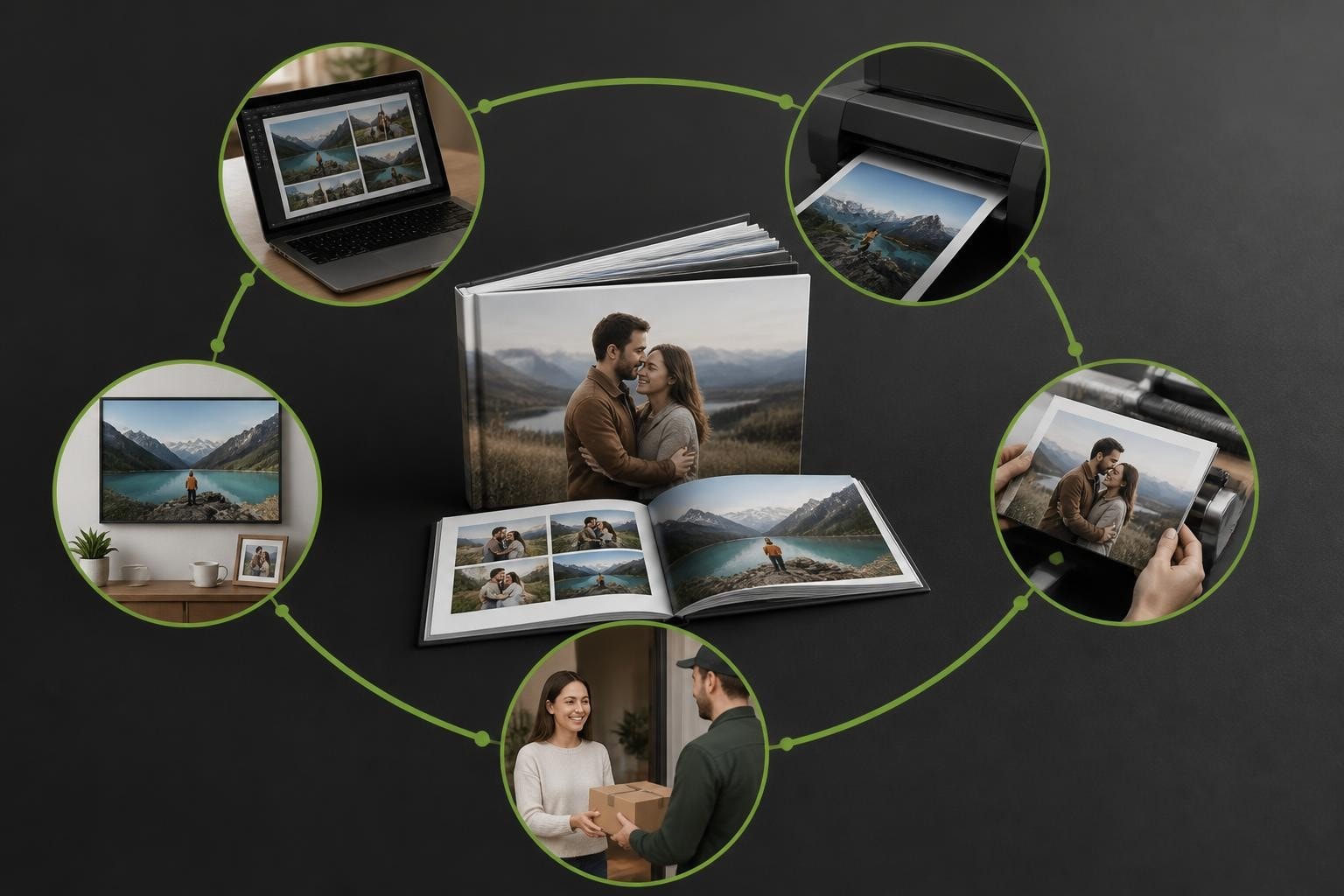
The photobook industry has transformed dramatically over the past two decades, evolving from a specialist niche into a global market worth billions. Understanding companies that make photo books requires looking beyond consumer-facing brands to explore the entire ecosystem-from software providers and technology platforms to production facilities and fulfilment specialists. This comprehensive guide examines the various types of businesses involved in photobook creation, their distinct roles, and how modern technology enables businesses to deliver high-quality personalised products.
The Photobook Industry Landscape
The photobook sector encompasses a diverse range of businesses, each playing a specific role in bringing personalised memory products to consumers. According to market research on the global photobooks and albums market, the industry continues to grow as consumers seek tangible ways to preserve digital memories.
Companies that make photo books typically fall into several distinct categories. Software developers create the design platforms that enable photobook creation. Production facilities handle the physical printing, binding, and finishing processes. Fulfilment centres manage order processing, quality control, and shipping. Many businesses combine these functions, whilst others specialise in specific areas.
Technology Providers and Platform Developers
Behind most photobook services sits sophisticated software that enables users to design, customise, and order their products. These technology companies develop the design interfaces, workflow management systems, and production automation tools that power the industry.
Platform providers focus on several key capabilities:
- Intuitive design interfaces for end users
- Automated layout generation and image placement
- Integration with production equipment and workflows
- Order management and fulfilment coordination
- Customisation options for business clients
Taopix exemplifies this category, providing white-label software solutions that enable businesses to offer photobooks and personalised print products under their own brands. Their technology supports flexible workflows and fully customisable user experiences, allowing businesses to differentiate their offerings whilst leveraging proven design tools.

Production Models and Manufacturing Approaches
Companies that make photo books employ various production models, each with distinct advantages and limitations. Understanding these approaches helps explain the diversity of offerings in the marketplace.
Digital Print-on-Demand
Most modern photobook businesses utilise digital printing technology, which allows single-copy production without minimum order quantities. This model enables mass customisation, where each book can be unique without additional cost.
Digital production facilities typically invest in high-quality inkjet or electrophotographic presses capable of reproducing photographs with excellent colour accuracy and detail. Production considerations such as photobook imposition and binding methods significantly influence the final product quality and manufacturing efficiency.
Traditional Offset Printing
Some companies still offer offset-printed photobooks for large quantities or premium editions. Whilst offset printing delivers exceptional colour consistency and lower per-unit costs at volume, it requires minimum print runs and cannot accommodate individual customisation economically.
| Production Method | Minimum Quantity | Customisation | Unit Cost | Turnaround |
|---|---|---|---|---|
| Digital POD | 1 book | Fully personalised | Higher for singles | 1-3 days |
| Offset Printing | 500+ books | Edition-based | Lower at volume | 2-4 weeks |
| Hybrid Approach | Varies | Limited options | Medium | 1-2 weeks |
Binding Technologies and Product Quality
The binding method fundamentally affects a photobook's appearance, durability, and user experience. Companies that make photo books differentiate themselves through the binding technologies they offer and the quality standards they maintain.
Lay-Flat Binding
Premium photobook services often feature lay-flat binding, which allows pages to open completely flat without a visible gutter. This binding method proves particularly valuable for panoramic photographs and two-page spreads.
Lay-flat construction requires specialised equipment and materials. Pages are typically mounted on rigid boards and joined with flexible hinges, creating a book that lies flat when opened whilst maintaining structural integrity.
Perfect Binding and Case Binding
Perfect binding glues individual pages to a wrap-around cover, creating a square spine similar to paperback books. Case binding uses sewn signatures enclosed in a hardcover case, offering enhanced durability and a traditional book aesthetic.
Quality considerations include:
- Paper weight and surface finish (matte, glossy, lustre)
- Colour calibration and profile accuracy
- Binding strength and page attachment
- Cover materials and protective coatings
- Edge finishing and trimming precision
Professional production facilities invest significantly in colour management systems to ensure consistent, accurate reproduction. Many award-winning digital photo album printers employ advanced quality control processes, including automated colour verification and manual inspection protocols.

White-Label Solutions and Business Models
Many companies that make photo books operate under white-label arrangements, where they produce photobooks branded for other businesses. This model allows retailers, photographers, and online services to offer photobooks without investing in production infrastructure.
The White-Label Advantage
White-label photobook production enables businesses to focus on customer experience, marketing, and brand development whilst partnering with specialist manufacturers for production and fulfilment. This separation of concerns allows for greater specialisation and efficiency.
Software platforms play a crucial role in white-label operations. Companies like H&H Color Lab have targeted increased market share by adopting flexible software solutions that enable them to serve diverse client needs whilst maintaining production efficiency.
The white-label model supports various business types:
- Professional photographers offering photobooks to clients
- Retail chains providing in-store and online photobook services
- Event specialists creating wedding, travel, and celebration albums
- Corporate clients producing marketing materials and corporate histories
- Educational institutions creating yearbooks and commemorative publications
Sustainability and Environmental Considerations
Environmental responsibility has become increasingly important for companies that make photo books. Both consumers and business clients now evaluate suppliers based on their sustainability practices and environmental credentials.
Research on what makes photobooks sustainable identifies several key factors, including paper sourcing, production processes, shipping methods, and end-of-life considerations. Companies committed to sustainability implement practices such as FSC-certified paper, vegetable-based inks, renewable energy use in production facilities, and optimised shipping logistics.
Sustainable Production Practices
Forward-thinking photobook manufacturers adopt comprehensive sustainability strategies that address their entire operation. Practical guidance on sustainable photobook publishing emphasises the importance of considering materials, processes, and supply chain decisions holistically.
Key sustainability measures include:
- Sourcing paper from responsibly managed forests
- Minimising waste through efficient imposition and cutting
- Using water-based or low-VOC adhesives and coatings
- Implementing energy-efficient production equipment
- Offering carbon-neutral shipping options
- Designing packaging for recyclability
Software Solutions and User Experience
The software interface fundamentally shapes the customer's photobook creation experience. Companies that make photo books invest heavily in design tools that balance creative flexibility with ease of use.
Design Interface Options
Modern photobook software typically offers multiple interface options to accommodate different user preferences and skill levels. Online design tools provide browser-based creation without software installation, whilst desktop applications offer enhanced performance and offline functionality.
Advanced platforms incorporate artificial intelligence to assist with layout creation, image selection, and design optimisation. These features help users create professional-quality photobooks even without design experience.
| Feature | Benefit | Target User |
|---|---|---|
| Automated layouts | Quick creation with smart image placement | Casual consumers |
| Manual design tools | Complete creative control | Professional photographers |
| Template libraries | Consistent, proven designs | Business users |
| AI enhancement | Improved image quality and cropping | All users |
| Collaborative editing | Multiple contributors | Corporate and family projects |
Industry Transformation and Market Evolution
The photobook industry continues to evolve as traditional print businesses adapt to digital workflows and personalised production. Legacy print companies are transforming their operations to serve photobook and personalised print markets, investing in digital equipment, software platforms, and new business processes.
This transformation reflects broader market trends towards personalisation, on-demand production, and direct-to-consumer fulfilment. Companies that make photo books must continually innovate to meet changing customer expectations regarding product quality, delivery speed, and user experience.
Market Segmentation and Specialisation
Successful photobook businesses increasingly focus on specific market segments rather than attempting to serve all customers equally. Specialisation allows companies to optimise their offerings, workflows, and marketing for particular customer types.
Common specialisation strategies:
- Premium wedding and event photography books
- Budget-friendly family albums and yearbooks
- Professional portfolio and exhibition books
- Corporate histories and brand publications
- Travel photobooks with map integration and journey features
Technical Infrastructure and Integration
Modern companies that make photo books require sophisticated technical infrastructure to manage the entire process from customer design to finished product delivery. This infrastructure typically includes design software, production workflow systems, order management platforms, and customer communication tools.
Production Workflow Automation
Efficient photobook production depends on seamless integration between design platforms and manufacturing equipment. Automated workflows eliminate manual data entry, reduce errors, and accelerate order processing.
Leading software solutions generate print-ready files with correct colour profiles, imposition, and finishing specifications. They communicate directly with digital presses, cutting equipment, and binding systems to orchestrate production without human intervention.

Quality Assurance and Customer Satisfaction
Companies that make photo books maintain rigorous quality control processes to ensure consistent results and minimise returns. Quality assurance begins with proper colour management and extends through every production stage.
Essential quality control points include:
- Pre-flight checking of customer files for resolution and colour space issues
- Automated colour calibration and profile verification
- In-process inspection during printing and binding
- Final product review before packaging
- Damage prevention during fulfilment and shipping
Many photobook providers offer satisfaction guarantees and reprint policies, recognising that printing memories carries significant emotional value for customers. Quality problems affect not just immediate satisfaction but also long-term brand reputation and customer loyalty.
International Operations and Localisation
Global companies that make photo books face unique challenges related to language support, regional preferences, shipping logistics, and regulatory compliance. Successful international operations require localised user interfaces, culturally appropriate templates, and distributed production facilities.
Regional production centres reduce shipping costs and delivery times whilst supporting local markets with appropriate product variations. For example, European customers may prefer square formats and lay-flat binding, whilst other markets favour traditional portrait-oriented albums with perfect binding.
Cross-Border Considerations
Operating internationally requires attention to various practical and regulatory matters. Companies must navigate customs regulations, VAT and tax collection requirements, data protection laws, and payment processing across multiple jurisdictions.
Software platforms supporting international operations must accommodate multiple currencies, languages, and regional customisation options. They should integrate with local payment processors and shipping carriers to provide seamless customer experiences regardless of location.
Business Partnership Models
Companies that make photo books often work through partnership arrangements that combine their strengths with complementary businesses. These partnerships enable broader market reach and enhanced service offerings.
Barcelona-based businesses targeting B2C markets demonstrate how production specialists partner with technology providers to expand their capabilities and serve new customer segments effectively. Such collaborations allow each partner to focus on their core competencies whilst delivering comprehensive solutions.
Partnership models vary from simple production outsourcing to fully integrated white-label arrangements with shared technology platforms and co-marketing initiatives. The most successful partnerships align strategic goals and maintain clear communication about capabilities, timelines, and quality standards.
The photobook industry encompasses a complex ecosystem of technology providers, production specialists, and service businesses, each contributing essential capabilities to deliver personalised memory products. Understanding how these companies operate, their production methods, and their quality standards helps businesses make informed decisions about partnerships and technology investments. Whether you're exploring photobook offerings for your business or seeking to understand the industry landscape, Taopix provides the software solutions and expertise to help businesses succeed in this dynamic market with flexible, customisable platforms that support diverse workflows and exceptional user experiences.