
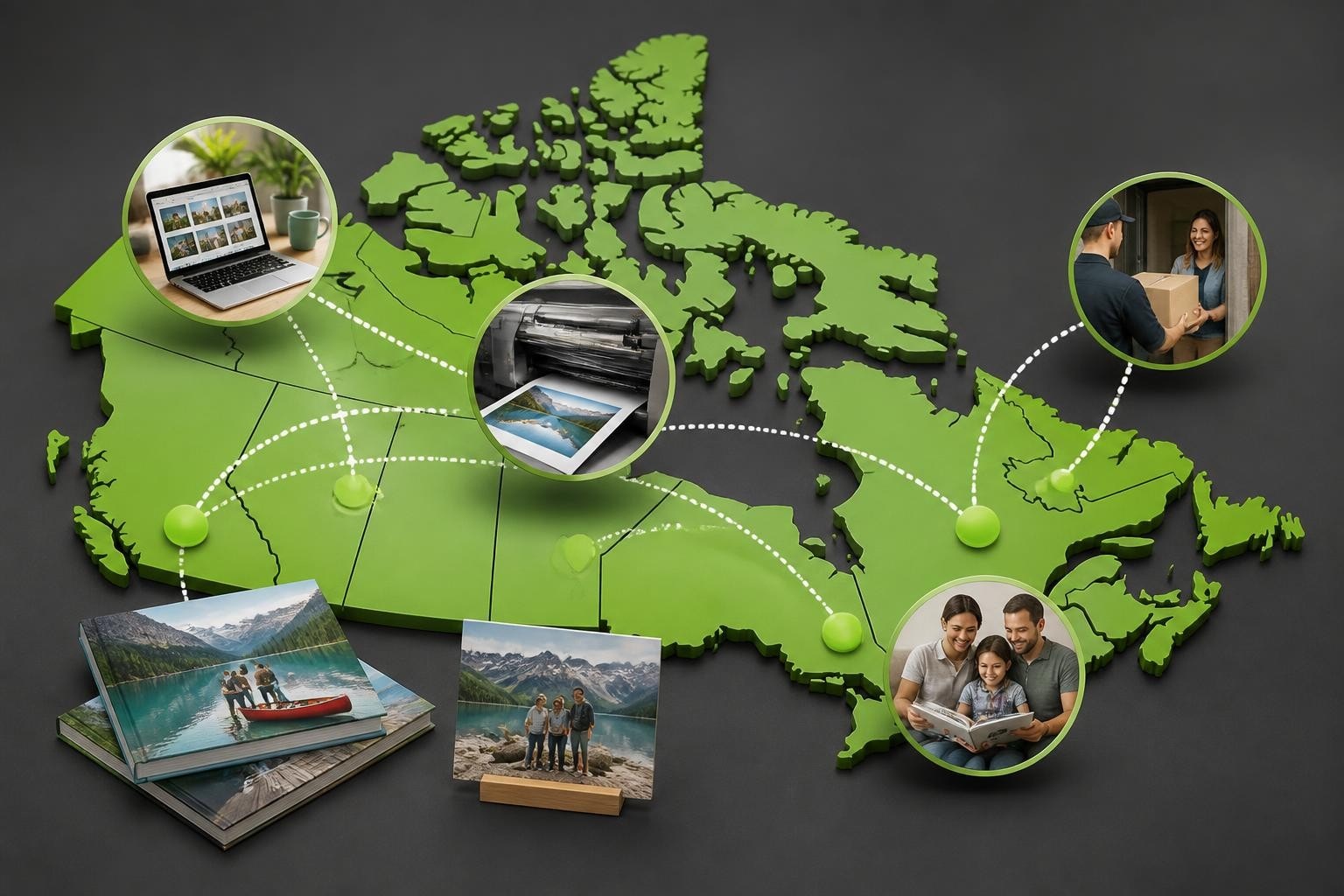
Creating and selling a photobook in Canada represents a significant business opportunity in 2026, with the Canadian print market continuing to evolve alongside digital consumption patterns. Whether you're a photography studio, print service provider, or creative agency, understanding the landscape for photobook production requires knowledge of market dynamics, regulatory requirements, production workflows, and technology platforms that enable personalised products at scale. This comprehensive guide explores the essential considerations for businesses operating in Canada's photobook sector, from software solutions and production standards to legal compliance and sustainable practices.
Understanding the Canadian Photobook Market
The photobook market forms part of Canada's broader book publishing industry, which generates substantial economic activity across provinces. Statistics Canada’s overview of Canada’s book publishing industry provides crucial context for understanding how photobooks fit within the larger print ecosystem, revealing trends in consumer spending and production volumes that directly impact personalised print products.
Canadian consumers demonstrate strong demand for physical keepsakes despite increasing digital consumption. This creates opportunities for businesses offering photobook in Canada production services, particularly those that combine convenience with high-quality output and personalisation options.
Market Segmentation and Opportunity
The photobook sector serves distinct customer segments:
- Professional photographers creating client deliverables and portfolio pieces
- Individual consumers preserving family memories and special occasions
- Corporate clients requiring branded presentations and anniversary publications
- Artists and creatives producing limited-edition photography books
- Educational institutions documenting events and creating yearbooks
Each segment demands different production capabilities, pricing models, and service levels. Businesses equipped with flexible software platforms can address multiple segments simultaneously, maximising revenue potential whilst managing operational complexity.

Regulatory Framework for Photobook Production
Operating a photobook business in Canada requires compliance with several regulatory frameworks that govern publishing, taxation, and archival preservation. Understanding these obligations prevents costly mistakes and ensures legitimate operation within Canadian law.
Legal Deposit Requirements
Library and Archives Canada’s legal-deposit guidance for physical publications establishes mandatory requirements for certain photobook publications. Publishers producing photobooks with ISBN numbers or those distributed publicly must deposit copies with Library and Archives Canada within one week of publication. This applies primarily to commercially published photobooks rather than private family albums, but businesses should understand when the obligation triggers.
The legal deposit system preserves Canada's published heritage whilst providing bibliographic control over national publications. Photobook businesses operating at scale need clear processes to identify which projects require deposit and ensure timely compliance.
Tax Obligations for Print Products
Canada Revenue Agency guidance on GST/HST for suppliers of publications clarifies tax treatment for photobooks. Generally, photobooks containing primarily photographs rather than text are taxable supplies subject to GST/HST at applicable provincial rates. This differs from certain books that qualify for zero-rating.
Understanding these distinctions ensures accurate pricing and tax collection. Businesses selling photobook in Canada services must configure their systems to charge correct tax rates based on customer location, as HST rates vary between provinces whilst others use separate GST and PST structures.
| Province/Territory | GST/HST Rate | Tax Type | Notes |
|---|---|---|---|
| Ontario | 13% | HST | Harmonised tax |
| British Columbia | 5% + 7% | GST + PST | Separate taxes |
| Alberta | 5% | GST | No provincial tax |
| Quebec | 5% + 9.975% | GST + QST | Provincial sales tax |
| Atlantic provinces | 15% | HST | Harmonised tax |
Technology Platforms and Production Workflows
Modern photobook production depends on sophisticated software platforms that manage the entire creation-to-fulfilment workflow. Businesses investing in robust technology gain competitive advantages through faster production, superior customisation, and better customer experiences.
Essential Software Capabilities
Professional photobook software must deliver comprehensive functionality across multiple touchpoints:
- Design interface enabling intuitive layout creation with drag-and-drop functionality
- Template management allowing businesses to offer curated starting points whilst permitting full customisation
- Asset management handling image uploads, processing, and quality verification
- Workflow automation routing orders through production stages with minimal manual intervention
- Output generation creating print-ready files meeting specific printer requirements
- Integration capabilities connecting with payment processors, shipping providers, and inventory systems
Taopix provides comprehensive solutions addressing these requirements, enabling businesses to launch photobook services without developing proprietary technology from scratch. Their fully customisable user experience adapts to different brand identities whilst maintaining consistent production workflows behind the scenes.
The right software platform transforms photobook production from a labour-intensive manual process into a scalable automated operation. This scalability proves essential for businesses experiencing seasonal demand fluctuations or planning expansion into new markets.
Subscription Models for Recurring Revenue
Photo book subscription services represent an emerging business model that converts one-time photobook purchases into predictable recurring revenue. By offering monthly or quarterly photobooks as part of subscription packages, businesses build customer loyalty whilst improving cash flow forecasting.
Subscription photobook services work particularly well for:
- New parents documenting baby milestones month by month
- Travel enthusiasts creating annual trip compilations
- Grandparents receiving regular family photo updates
- Corporate clients producing quarterly team newsletters or project documentation
Implementing subscription functionality requires software platforms that handle recurring billing, automated reminders, and template variations that keep each edition fresh whilst maintaining production efficiency.
Quality Standards and Production Specifications
Professional photobook in Canada production demands adherence to quality standards that ensure customer satisfaction and minimise returns or reprints. Establishing clear specifications and quality control processes protects business reputation whilst controlling costs.
Print and Binding Specifications
High-quality photobooks require careful attention to multiple production variables:
Paper specifications:
- Weight range between 170-300gsm depending on page count and binding method
- Surface finish (glossy, matte, lustre, or silk) suited to photographic content
- Colour accuracy maintained through calibrated printing equipment
- Archival quality for longevity, particularly important for family heirlooms
Binding options:
- Layflat binding allowing images to span across spreads without gutter loss
- Perfect binding for cost-effective production of higher page counts
- Hardcover casebound construction for premium products
- Wire-o or spiral binding for functional applications requiring open-flat capability
Colour management:
- ICC profile matching between design software and production equipment
- Soft proofing capabilities allowing customers to preview colour rendering
- Consistent calibration schedules ensuring colour consistency across print runs

File Preparation and Preflight Checks
Automated preflight verification prevents production delays and quality issues. Software platforms should validate:
- Image resolution meets minimum DPI requirements (typically 300 DPI at final size)
- Colour space conversion from RGB to CMYK where required
- Bleed areas extend beyond trim marks sufficiently (usually 3-5mm)
- Text and critical elements remain within safe zones avoiding trim damage
- Total page count aligns with binding method constraints
- File formats comply with printer specifications
Comprehensive preflight checking reduces production errors whilst educating customers about technical requirements. Clear error messages guide users toward corrections rather than frustrating them with cryptic technical jargon.
Sustainable Production Practices
Environmental responsibility increasingly influences purchasing decisions, making sustainable practices both ethically important and commercially advantageous for photobook businesses. Canadian consumers demonstrate growing preference for environmentally conscious products, creating opportunities for businesses that prioritise sustainability.
Sustainable Materials and Certifications
FSC Canada’s resources on paper, print and packaging provide guidance for sourcing certified sustainable papers that meet environmental standards without compromising quality. Forest Stewardship Council certification verifies that paper originates from responsibly managed forests, addressing consumer concerns about deforestation and environmental impact.
Photobook businesses can differentiate themselves through:
- FSC-certified paper stocks across all product ranges
- Vegetable-based inks reducing chemical content and improving recyclability
- Water-based coatings for protective finishes without harmful solvents
- Recycled content papers where quality standards permit
- Carbon-neutral shipping options for environmentally conscious customers
Sustainability certifications provide marketing advantages whilst contributing to genuine environmental improvement. Businesses should communicate their environmental commitments clearly without greenwashing, backing claims with verifiable certifications and transparent reporting.
Local Production and Supply Chains
Producing photobooks domestically within Canada reduces transportation emissions whilst supporting local economies. Businesses can optimise their environmental footprint through:
- Regional production facilities serving different Canadian markets
- Domestic paper sourcing from Canadian mills
- Consolidated shipping combining multiple orders to reduce trips
- Recyclable packaging minimising waste at customer delivery point
- Print-on-demand production eliminating inventory waste
Copyright and Intellectual Property Considerations
Photobook production involves complex copyright issues requiring clear policies and customer education. Professional Photographers of Canada’s advocacy resources provide authoritative guidance on copyright ownership, licensing, and best practices for protecting both photographer rights and business interests.
Rights Management for Photobook Content
Businesses offering photobook in Canada services must establish clear policies regarding:
Image rights and ownership:
- Copyright remains with the original photographer unless explicitly transferred
- Customers must possess rights or permissions for all images included
- Model releases required for commercial use of recognisable individuals
- Location permissions necessary for certain private property images
Terms of service provisions:
- Liability disclaimers protecting the business from copyright infringement by customers
- Verification processes confirming customers own or have licensed submitted content
- Automated scanning for watermarks or copyright indicators suggesting unauthorised use
- Clear refusal rights when copyright concerns arise
Professional photographer relationships:
- Licensing agreements specifying permitted uses and reproduction limits
- Revenue sharing models when photographers sell photobooks to clients
- Print release provisions allowing end-customer printing through third-party services
- Digital proof approval workflows ensuring photographer control over final output
Implementing robust rights management protects your business from legal liability whilst respecting intellectual property rights throughout the creative community.
Pricing Strategies and Market Positioning
Successful photobook businesses develop pricing strategies balancing competitive positioning with sustainable profitability. Canadian market dynamics, production costs, and customer expectations all influence optimal pricing approaches.
Cost Structure Analysis
Understanding complete cost structures enables informed pricing decisions:
| Cost Category | Typical Percentage | Key Variables |
|---|---|---|
| Materials | 25-35% | Paper quality, binding method, page count |
| Production | 15-25% | Labour, equipment, utilities, facility |
| Software/Technology | 10-15% | Platform fees, maintenance, development |
| Fulfilment | 8-12% | Packaging, shipping, handling |
| Marketing | 10-15% | Advertising, content, customer acquisition |
| Overhead | 8-12% | Administration, insurance, professional services |
| Profit Margin | 15-25% | Target return on investment |
These percentages vary based on business model, production volume, and market positioning. High-volume operations achieve better material costs through bulk purchasing, whilst boutique studios command premium pricing through superior service and specialisation.
Value-Based Pricing Models
Beyond cost-plus calculations, value-based pricing recognises that customers pay for perceived value rather than production costs alone. Photobook businesses can capture additional value through:
- Premium design services offering professional layout assistance
- Expedited production for rush orders with tight deadlines
- Enhanced materials including upgraded papers, premium bindings, or special finishes
- Concierge service providing dedicated support and revision assistance
- Bundled packages combining photobooks with complementary products
Barcelona’s Serafi targets B2C market with Taopix demonstrates how businesses leverage technology platforms to address consumer markets effectively, balancing automation with personalisation to deliver value at competitive price points.
Distribution Channels and Market Reach
Photobook businesses access Canadian customers through multiple distribution channels, each offering distinct advantages and requiring different operational capabilities. Successful operations often employ multi-channel strategies maximising market coverage whilst managing channel complexity.
Direct-to-Consumer Models
Direct sales eliminate intermediary margins whilst providing complete control over customer relationships. Online platforms enable nationwide reach without physical retail presence:
Advantages:
- Higher profit margins retaining full retail value
- Direct customer data enabling targeted marketing and retention
- Complete brand control throughout customer journey
- Flexibility to test pricing and promotional strategies rapidly
Requirements:
- Robust e-commerce platform handling transactions securely
- Digital marketing capabilities driving traffic and conversions
- Customer service infrastructure managing enquiries and issues
- Shipping and logistics managing delivery across Canadian geography
B2B Partnership Channels
Business-to-business relationships extend market reach through established customer bases. H&H Color Lab targets increased market share with Taopix illustrates how professional labs leverage technology partnerships to enhance service offerings and capture greater market share.
Partnership opportunities include:
- Photography studios offering photobooks as client deliverables
- Event planners providing commemorative photobooks for weddings and corporate events
- Retail photography chains adding photobooks to product portfolios
- Corporate gift suppliers including photobooks in executive gift programmes
- Tourist attractions creating souvenir photobooks for visitors
B2B channels require different support structures including wholesale pricing, white-label options, API integrations, and dedicated account management for key partners.

Provincial Market Considerations
Canada's vast geography and provincial diversity create regional market variations affecting photobook business operations. Understanding provincial differences enables targeted strategies maximising effectiveness whilst managing operational complexity efficiently.
Regional Market Characteristics
Different provinces present distinct opportunities and challenges:
Ontario:
- Largest market by population concentration
- Strong photography community and creative sector
- Ontario Creates’ industry profile for book publishing provides detailed market insights
- Competitive landscape with numerous established providers
Quebec:
- Unique linguistic requirements necessitating French-language interfaces
- Strong cultural identity favouring local production
- Separate tax administration requiring QST registration
- Bilingual customer service essential for market success
Western provinces:
- Growing markets with increasing population
- Distance from central production creates shipping challenges
- Strong outdoor and adventure photography communities
- Opportunity for regional production facilities serving local markets
Atlantic provinces:
- Smaller population but tight-knit communities
- Tourism-related photobook demand seasonally concentrated
- Shipping costs proportionally higher
- Partnership models more efficient than direct operations
Funding and Growth Opportunities
Canadian businesses and creatives producing photobooks can access various funding sources supporting production, marketing, and business development. Canada Council for the Arts funding programmes support artistic photobook projects, particularly those with cultural or artistic merit beyond commercial applications.
Grant and Support Programmes
Multiple funding sources assist photobook-related ventures:
- Arts council grants supporting photographer-authored photobooks with artistic vision
- Small business loans financing equipment, technology, and working capital
- Export development programmes assisting businesses expanding beyond Canadian borders
- Technology adoption grants subsidising software implementation and digital transformation
- Regional development funds encouraging business establishment in specific provinces or communities
Businesses should research federal, provincial, and municipal programmes relevant to their specific circumstances, as eligibility criteria and application processes vary significantly between programmes.
Technology Integration and Automation
Modern photobook businesses maximise efficiency through technology integration connecting customer-facing interfaces with backend production systems. Seamless integration reduces manual intervention, minimises errors, and accelerates order fulfilment.
Essential System Integrations
Comprehensive photobook platforms integrate with:
- Payment processors enabling secure transactions across multiple payment methods
- Shipping carriers providing real-time rate calculation and automated label generation
- Inventory management tracking paper stocks, binding materials, and component availability
- Customer relationship management maintaining customer histories and enabling targeted communications
- Accounting systems automating financial record-keeping and tax reporting
- Production equipment sending print-ready files directly to digital presses and finishing equipment
BookNet Canada’s 2024 Canadian book market highlights reveal industry trends including digital adoption rates and distribution channel evolution that inform technology investment priorities for photobook businesses.
Mobile-First Design Approaches
Canadian consumers increasingly design and order photobooks using mobile devices, making mobile-optimised interfaces essential for market success. Mobile-first design requires:
- Responsive layouts adapting seamlessly to various screen sizes
- Touch-optimised controls replacing mouse-based interactions
- Simplified workflows recognising mobile usage contexts and attention limitations
- Cloud synchronisation allowing customers to begin projects on mobile and continue on desktop
- Native apps providing enhanced performance and offline functionality where justified
Businesses neglecting mobile experiences risk losing significant market share as mobile commerce continues growing across Canadian demographics.
Customer Service Excellence
Exceptional customer service differentiates photobook businesses in competitive markets where product quality increasingly converges. Superior service creates customer loyalty, generates referrals, and justifies premium pricing through enhanced value delivery.
Support Channel Strategies
Effective customer support employs multiple channels addressing different customer preferences:
Self-service resources:
- Comprehensive knowledge bases answering common questions
- Video tutorials demonstrating design techniques and software features
- Template galleries inspiring customers and showcasing possibilities
- Automated chatbots handling routine enquiries instantaneously
Human support:
- Email support for non-urgent detailed questions
- Phone support for complex issues requiring real-time dialogue
- Live chat for immediate assistance during design sessions
- Design consultation services for premium customers requiring expert guidance
Balancing automation with human touch optimises cost efficiency whilst maintaining service quality. Clear escalation pathways ensure complex issues receive appropriate attention from qualified staff.
Quality Guarantee and Returns Management
Clear quality guarantees build customer confidence whilst establishing boundaries managing expectation and liability. Comprehensive policies should address:
- Production defects covered under warranty requiring replacement or refund
- Customer errors in design or content not constituting production faults
- Colour variations acknowledging inherent differences between screen and print
- Shipping damage establishing carrier liability and claim procedures
- Time limitations specifying inspection periods and claim deadlines
Transparent policies prevent disputes whilst demonstrating commitment to customer satisfaction. Photobook in Canada businesses must balance generous guarantees building confidence against protection from unreasonable claims.
Emerging Trends and Future Opportunities
The photobook market continues evolving through technological advancement, changing consumer preferences, and emerging business models. Forward-thinking businesses position themselves to capitalise on developing trends whilst maintaining core competencies in quality production and customer service.
Artificial Intelligence and Automation
AI technologies increasingly influence photobook creation through:
- Automated layout generation analysing photo content and suggesting optimal arrangements
- Intelligent cropping and enhancement improving image quality automatically
- Content curation selecting best images from large collections
- Personalised recommendations suggesting products and designs based on customer history
- Predictive production forecasting demand and optimising inventory
These capabilities democratise professional-quality design whilst accelerating creation workflows. Businesses implementing AI features attract customers valuing convenience alongside customisation.
Augmented Reality Integration
Augmented reality features add interactive dimensions to traditional photobooks:
- Embedded video content accessible through smartphone scanning of printed pages
- Audio narratives providing spoken context for photographs
- 3D visualisation revealing additional perspectives of photographed subjects
- Social media integration connecting printed content with digital sharing
AR-enhanced photobooks command premium pricing whilst creating memorable experiences transcending static print media. Early adopters gain competitive advantages as technologies mature and customer awareness grows.
Creating successful photobook businesses in Canada requires understanding market dynamics, regulatory compliance, production technology, and customer expectations across diverse provinces and segments. From sustainable materials and copyright management to pricing strategies and distribution channels, multiple factors influence operational success and competitive positioning.
Whether you're launching new services or enhancing existing photobook capabilities, the right technology foundation proves essential for scalability and customer satisfaction. Taopix provides comprehensive software solutions enabling businesses to deliver personalised photobooks efficiently whilst maintaining complete brand control and operational flexibility. Their customisable platforms adapt to your specific requirements, supporting growth from initial launch through national expansion across Canada's diverse markets.